
About the project
This project focuses on the risk characterization of ciguatera food intoxication.
Project data
Years in the project
People involved
Tests
Studio Locations
Project overview
Project summary
Adaptation of the ciguatera in Spain and improvement of its management (CIGUAADAPT)
Ciguatera, also known as ciguatera fish poisoning (CFP), is caused by the ingestion of marine fish containing ciguatoxins (CTXs), which are very potent neurotoxins, mainly present in tropical and subtropical areas, however their presence in more temperate regions has been already reported. CTXs are produced by dinoflagellates of the genera Gambierdiscus and Fukuyoa. These genera have been described as a widespread and high diversity component in the Canary Islands (CI). At present, six species have been recorded but climate change may have promoted higher population densities and migrations. Since 2004, cases of ciguatera have reported in the CI and in Madeira. By contrast, in the Mediterranean Sea, no convincing evidence of cases of ciguatera exist, even though Gambierdiscus spp. have been reported in Crete, Cyprus and since 2017 in the Balearic Islands (BI). In our previous project, CIGUARISK, distribution of Gambierdiscus and Fukuyoa was evaluated over 3-year time-line in the CI and BI, however further work is needed. Additionally, the analysis of CTXs is highly challenging, the harmonization of the protocols is crucial, as no official method is yet available.
The main objective of CIGUAADAPT is to adapt our society to the establishment of ciguatera as a persistent situation, in order to protect consumers, advice the fish production sector and improve ciguatera management. The Project is subdivided into 5 Working Packages (WP). In the Project WP1, the evaluation of the climate change (CC) impact on the occurrence of Gambierdiscus and Fukuyoa in the Mediterranean Islands close to the Iberian Peninsula and the BI is assessed. The WP2 will be focused on the characterization of ciguatera-causing dinoflagellates ecophysiology and understanding the dinoflagellate communities and their patterns. The description of the toxin production process through multifactorial analyses will be also covered.
CIGUAADAPT WP3 will work on the identification and quantification of the CTXs, and on defining how CTXs accumulate. All these data will be brought together in WP4, where management tools will be proposed to adapt our society to the establishment of ciguatera as a persistent situation since 2004. Moreover, an integrated risk assessment model will be built in order to predict when ciguatera may occur, hence protecting consumers and providing timely advice to the aquaculture and fishing sectors. Additionally, these study areas offer a unique opportunity to evaluate ciguatera ecology, understanding the adaptation of ciguatera-causing dinoflagellates related to climate change. Finally, the WP5 compiles the management, dissemination and exploitation of the project.
Work packages
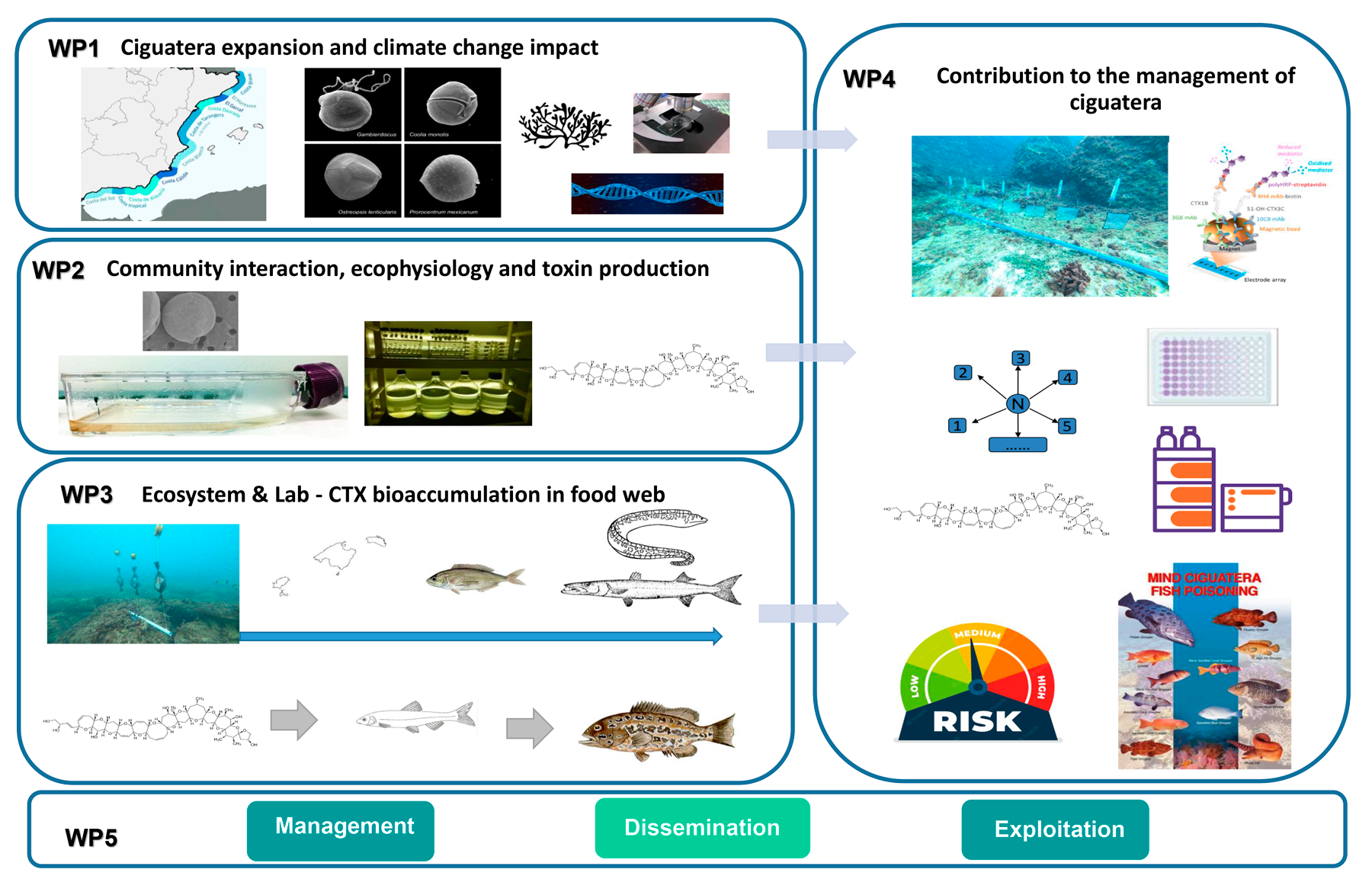
Work Package 1. Ciguatera expansion and climate change impact
Objectives
-Evaluate the impact of CC on the occurrence of Gambierdiscus and Fukuyoa: Assessment in islands on the Mediterranean close to the Iberian Peninsula, and in specific locations in the BI.
-Describe the impact of environmental factors on Gambierdiscus and Fukuyoa communities.
-Characterise through multifactorial analysis the environmental drivers on ciguatera-causing dinoflagellate communities.
Work Package 2. Community interaction, ecophysiology, and toxin production
Objectives
-Describe other communities’ interaction with Gambierdiscus and Fukuyoa / Identification of community indicators and influence of physico-chemical factors.
-Ecophysiology: study of mucus production in Gambierdiscus. Impact of mucus production under turbulence stress.
-Describe, through multifactorial analysis, the process of toxin production in ciguatera causing-dinoflagellates
Work Package 3. CTX bioaccumulation in the food web
Objectives
-Identify and quantify CTXs, and evaluate their toxicity, in high predator fish in the field, enabling risk assessment through the food web.
Work Package 4. Contribution to the management of ciguatera
Objectives
-Implementation of screening methods for the detection of CTXs and CTX-producing organisms to facilitate the monitoring of ciguatera / Implementation of community indicators.
-Improve analytical approaches: evaluate the potential interferences of other toxins in CTXs analysis and conduct an interlaboratory study on CTX analysis.
-Risk assessment of ciguatera in the studied areas.
-Develop scientific dissemination tools within communication strategies to prevent ciguatera cases / Favour multidisciplinary platforms to improve communication strategies.
Work Package 5. Management, dissemination and exploitation
Do you want to contact us?
For further information on the project or interest on the topic, contact us!